
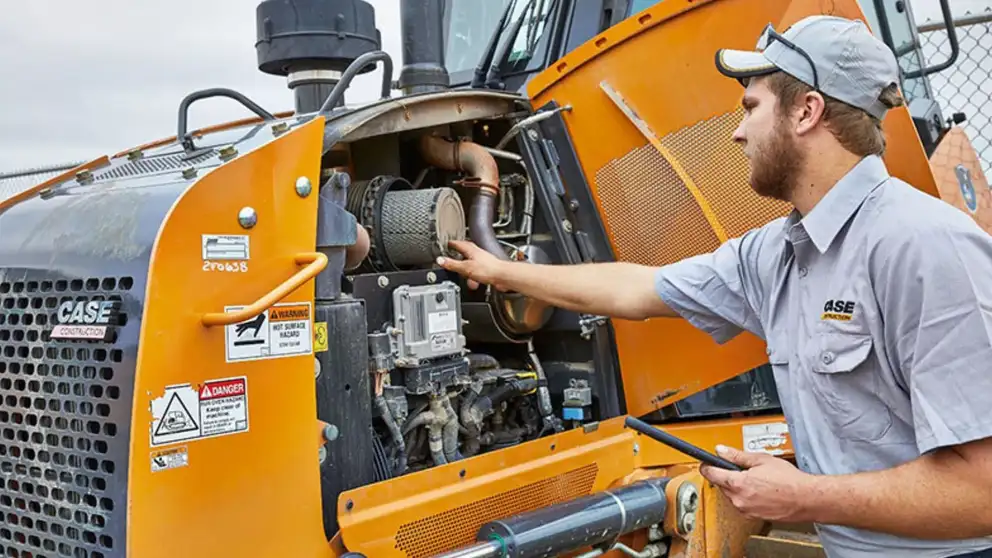
Construction equipment doesn’t forgive guesswork. A hydraulic excavator with a 300-plus horsepower engine and a dozen interlinked hydraulic circuits isn’t something you want to troubleshoot by trial and error, and that’s exactly why a proper Case construction service manual exists — to replace guessing with a documented, tested procedure for every major system on the machine.
Construction Equipment Isn’t Agricultural Equipment, and the Manuals Reflect That
It’s worth separating this out clearly: Case’s construction equipment line — excavators, wheel loaders, dozers, backhoe loaders, skid steers, compact track loaders — uses different hydraulic architectures, different undercarriage systems, and different electronic control strategies than Case IH’s agricultural tractors and implements. If you’ve been handed the wrong category of manual, you’ll notice quickly, because nothing in it will match the hydraulic valve bodies or track tensioning systems sitting in front of you. Always confirm you’re looking at construction equipment documentation specifically, matched to your machine’s model and serial number range.
Core Sections You Should Expect to Find
A complete service manual for Case construction equipment is typically organized by system, which makes it far easier to navigate than trying to search through a single undifferentiated document. Expect sections covering:
- Engine service, including fuel system, cooling system, and emissions equipment specific to the machine’s tier rating
- Powertrain and transmission, with torque specs and rebuild sequences
- Hydraulic system, broken down by circuit (boom, bucket, swing, travel, auxiliary) with pressure specifications and troubleshooting trees
- Undercarriage service for tracked machines — track tension, roller and idler wear limits, sprocket replacement
- Electrical and electronic systems, including controller diagnostics on machines with onboard computers
- Operator cab and controls, including joystick calibration on electronically controlled models
- Scheduled maintenance intervals tied to operating hours
Why Tier Rating Changes the Procedure
If your machine was built after roughly 2011, there’s a good chance it falls under Tier 4 Interim or Tier 4 Final emissions regulations, which means it likely has a diesel particulate filter, selective catalytic reduction system, or both. These systems add entire sections to the service manual that simply don’t exist for earlier mechanical-engine machines — DEF system service, DPF regeneration procedures, and additional sensor diagnostics. Using a manual written for a pre-Tier 4 machine on a Tier 4 Final unit means missing an entire category of maintenance your machine actually needs.
Hydraulic Troubleshooting: Where the Manual Earns Its Keep
Construction equipment lives and dies by its hydraulics, and this is where a good service manual really pays for itself. Rather than chasing a slow boom function or a swing circuit that feels weak by guessing at pump pressures, the manual walks you through a structured diagnostic sequence — check relief valve settings, verify pump output against spec, isolate the circuit, and confirm which component is actually at fault before you start pulling things apart. On a machine where a single hydraulic pump can cost thousands of dollars to replace, that structured approach isn’t a luxury, it’s how you avoid replacing a perfectly good component because you misdiagnosed the problem.
Wiring Diagrams and Electronic Controllers
Modern Case construction machines run on a network of electronic controllers managing everything from engine performance to hydraulic flow sharing. When something isn’t working right, a dedicated wiring diagram — ideally a clean, legible one rather than a degraded scan — becomes essential for tracing a fault back to its source rather than randomly swapping sensors and hoping one of them was the problem.
Keep It Matched, Keep It Current
Case updates service information as running changes happen during a model’s production life, so if you’re working on a machine near the edge of a model’s serial number range, double-check that the manual version you have actually reflects your machine’s specific build. A five-minute check against the serial plate at the start of a job is a lot less painful than discovering a torque spec or hydraulic pressure value doesn’t match what you’re looking at halfway through.
Construction equipment represents a serious investment, and the service manual is what protects that investment by making every repair a documented procedure instead of an educated guess. Get the right one for your exact machine, and the rest of the job gets a lot more straightforward.
 01
 02